@carl-westman_8110 very happy to hear it, thanks for the kind words :)
Welcome to the Inedo Forums! Check out the Forums Guide for help getting started.
If you are experiencing any issues with the forum software, please visit the Contact Form on our website and let us know!
 A
Offline
A
Offline
Posts
-
RE: What is the V symbol on universal packages?
-
RE: What is the V symbol on universal packages?
@carl-westman_8110 it's definitely a nifty and convenient function, but a poor feature from a product standpoint.
Users don't expect functionality to bundle content like this, so they won't use it unless we push it -- and to do that, we need to articulate benefits, show how it's a better solution than what they're doing now, and convince them to take the time to switch.
That's obviously a lot of work, on top of all the code to get it working.
I know a handful of users have found some value in virtual packages (and we use it internally), but being reminded about them now -- with about a decade more of experience behind me -- it feels like the wrong thing to focus on at the time, with limited resources.
That said, it doesn't even come close my top 10 worst product choices... so probably better we built that, than something else

Alex
-
RE: What is the V symbol on universal packages?
Hi @carl-westman_8110 ,
It's a Virtual Package; they're kind of a niche solution that, in retrospect, we probably shouldn't have created them.
Alex
-
RE: License Usage Overview - Non-compliant Licenses in Use
Thanks for clarifying @sebastian
So I'm not exactly thrilled by this UI, but maybe this is fine.
What do you think?
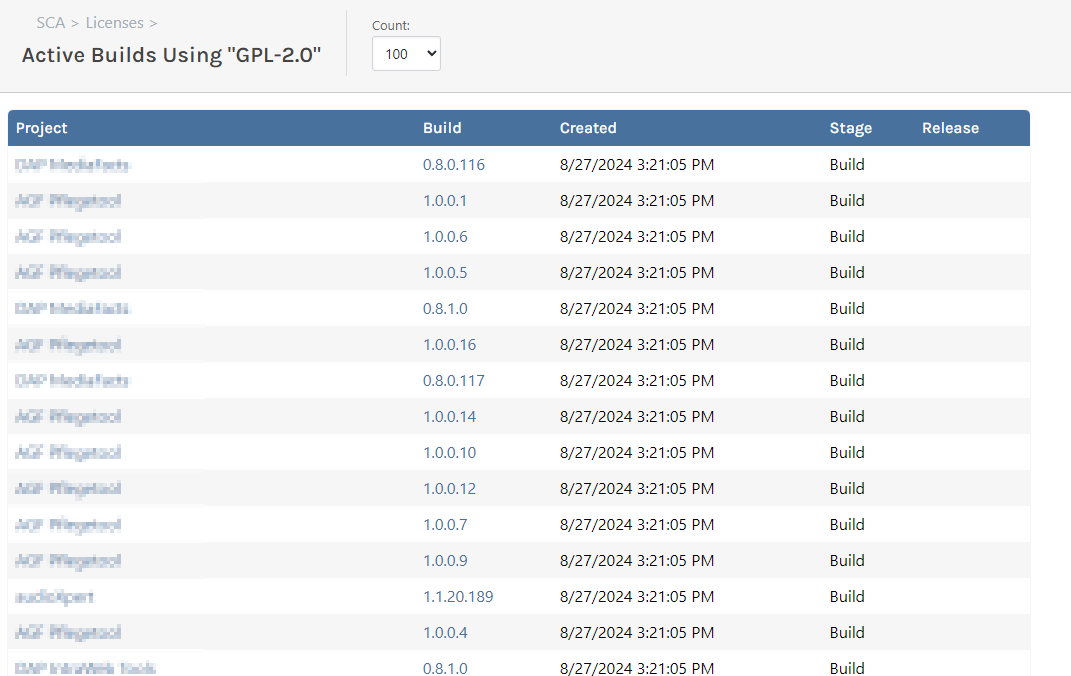
This is a kind of "quick and dirty" page that would show up if you clicked on that
GPL-2.0license and the "# projects" number.Here's one for the packages as well:
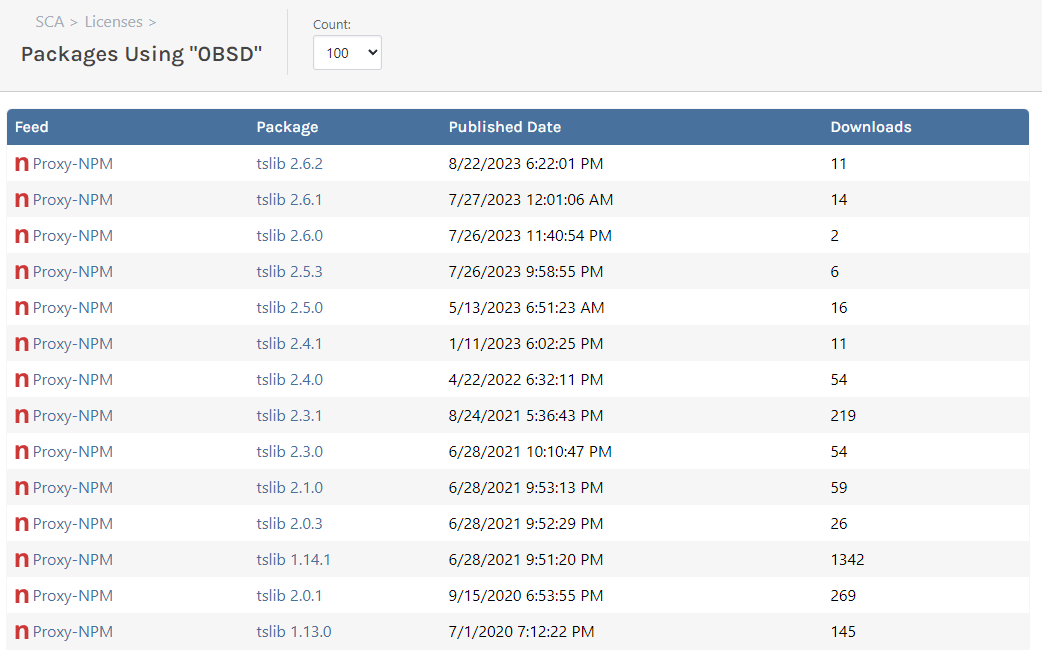
-
RE: ProGet & new Python development environment
Hi @stuart-houston_1512 ,
If you're using almost entirely libraries that are available on PyPI.org and Anacaond.org, that makes the most sense. Users probably won't notice much of a difference.
Once libraries start being pulled through ProGet, you can start setting up policies/compliance rules to restrict packages. Or at least get warned about them.
At some point you can set up a package approval workflow, but I usually don't recommend that from "day one" - it's a bit too restrictive for end users, who are used to any package, any time.
If it's easy for you to identify first-party packages (maybe they are prefixed with
MyCorpor something), then you can bring those in with bulk import. If no one uses (downloads) them after while, you can delete them with retention policies.Cheers,
Alex -
RE: ProGet & new Python development environment
Hi @stuart-houston_1512 ,
I would go with the second option, i.e. migrating packages from your internal repository to ProGet. It should be relatively easy to do this with a bulk file-system import.
The concern I would have with trying to configure ProGet up as a "proxy" to an old, internal conda repository you configured is that ProGet doesn't really operate as a "proxy" (i.e. blindly forwarding requests), but instead aggregates results from multiple sources using an API.
The Conda API isn't very well documented, doesn't provide much metadata about packages, and an old internal server will most certainly have bugs/quirks that ProGet would never be aware of. So your end users will end up with a buggy experience.
Connecting to the official Anaconda repositories is fine, and if there are any issues/bugs (like they change the API or something), we can easily reproduce and fix it.
Alex
-
RE: License Usage Overview - Non-compliant Licenses in Use
@sebastian I like that idea!
That information is readily linked in the database, so it's just a matter of figuring out how to get ProGet to display it.
Did you guys see the "Noncompliant packages" report (i.e.
/sca/compliance-report)?This is by far the easiest pattern: a non-sortable list of the top 100/500/1000 items.
That means your "show packages with
Apache-2.0licenses" wouldn't show everything, but I can't imagine you'd want to do that anyway. I'm thinking, you'd want to see the 7 packages withArtistic-2.0instead.I'd also like to ditch the "License Usage Issues" infobox, or at least replace it with something useful. It made sense with the ProGet 2023 license rules, but with policies we cannot easily query why a package/build is noncompliant.
-
RE: Support for Dart/Flutter pub.dev package repo
Good news everyone, ProGet 2024.11 now has support for pub (Dart/Flutter) feeds! I'm going to lock this topic now, but if you run into any issues please start a new topic
cc/ @aaron-bryson_0311 @fabian-droege_8705 @proget-markus-koban_7308 @jensen-chappell_6168 @harald-somnes-hanssen_2204 @bvandehey_9055
-
RE: Support for Dart/Flutter pub.dev package repo
Hi everyone,
Quick sneak peak of the work-in-progress:
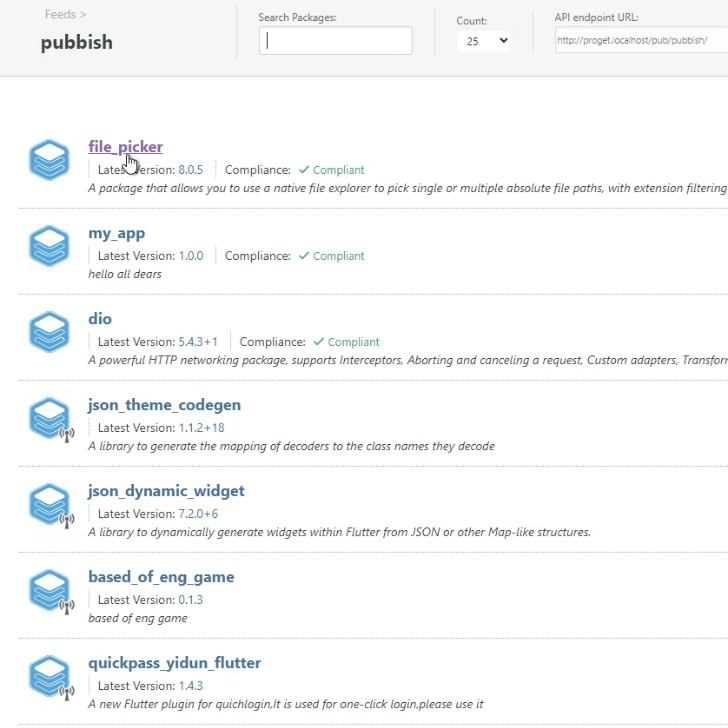
Cheers,
Alex -
RE: Linux Performance & SQL Server Issues
Turns out the errors I encountered were entirely related to the "new" SQL Server driver that ProGet 2024 was using. Although this was in beta for well over a year, it was "only" in production for a few months by the time we incorporated it into ProGet. This driver issue impacts anyone who uses .NET on Linux.
As I mention, I think it's pretty clear that Microsoft has effectively abandoned SQL Server. It's one thing to release something this low-quality and untested... and another to have it linger with issues like this in production for months. We will be moving to Postgres, which do not have these endemic problems.
In the meantime, I have instituted the "one year rule" for Microsoft products - meaning, unless it's been shipped in their general release channel for a year, we will not even consider using it.
-
RE: Linux Performance & SQL Server Issues
@sebastian thanks for sharing!
The issue that are describing sounds like more like the "ASP.NET Firehose" problem, and less like this obnoxious driver problem. They're both really obnoxious problems

The firehose problem hit basically anyone who went from .NET Framework to .NET Core, and had a high-traffic application. Basically, Microsoft gutted all of the "request throttling" that was in ASP.NET, which took into consideration a lot of factors, from system resources to processor type to cores, etc., and then queued requests appropriately --- now it's just left for the "user" to handle.
It was on the .NET8 roadmap to get fixed, but I guess they gave us a broken sql driver instead.
Anyway... great to hear the request throttle did the trick. I'm thinking we should just ship with a default of 100 and leave it at that. Maybe "wrap" some of the performance errors and advise the user to adjust the limit down or something.
-
Linux Performance & SQL Server Issues
I wasn't quite ready to write a blog post on this, but I figured I'd journal my thoughts on the forums to start - in the event that anyone is experience Linux performance issues with SQL Server.
Background: Low Linux Servers for ProGet Cloud Trial Edition
I've been "playing around" with low-spec Linux VMs (1-2 vCPU, 2-4 GB) for the purposes of creating "cloud trials" of ProGet. Eventually, I'd like to offer new users the ability to fill out a form on my.inedo.com that would automatically provision a server for them to evaluate.... but since we're paying for the resources, I want to keep our costs low.
We would never recommend such a low spec for production usage, but its fine for testing. That is, until a powerful developer machine hits it with an onslaught of requests during a NuGet or npm restore. This means hundreds of requests per second that need to be proxied to public repositories if the packages aren't cached.
To simulate this, I wrote a basic C# console program that just downloaded 1000's of packages in parallel from NuGet/npm feeds on ProGet with no caching enabled. This means that each request will trigger database queries and outbound requests to nuget.org. It's a DoS program, basically.
My goal was to find out what combination of settings would allow ProGet to not totally crap out during evaluation usage, and maybe discover a way to warn users that ProGet is under heavy load.
Unexpected Problem: Broken Microsoft SQL Server Driver
WAS: Unexpected Problem: Linux SQL Server Warmup Required

Turns out the errors I encountered were entirely related to the "new" SQL Server driver that ProGet 2024 was using. Although this was in beta for well over a year, it was "only" in production for a few months by the time we incorporated it into ProGet. This driver issue impacts anyone who uses .NET on Linux.
As I mention below, I think it's pretty clear that Microsoft has effectively abandoned SQL Server. It's one thing to release something this low-quality and untested... and another to have it linger with issues like this in production for months. We will be moving to Postgres, which do not have these endemic problems.
In the meantime, I have instituted the "one year rule" for Microsoft products - meaning, unless it's been shipped in their general release channel for a year, we will not even consider using it.
I noticed that if I ran my DoS program shortly after the container started, I would see a flood of messages like this: Microsoft.Data.SqlClient.SqlException (0x80131904): A network-related or instance-specific error occurred while establishing a connection to SQL Server. The server was not found or was not accessible. Verify that the instance name is correct and that SQL Server is configured to allow remote connections. (provider: TCP Provider, error: 35 - An internal exception was caught)That was not at all expected.After researching this a bit, it looks like this is a well-known, multi-year bug in the Microsoft's SQL Server driver for Linux. It's documented in their GitHub repository, and it plagues even Microsoft's own business-line products. There's no ETA and virtually no response form Microsoft on the matter but it's endemic in their driver.Long story short, low-spec Linux instance of ProGet needs to "warmup". There is some kind of bug in the client that is triggered when you try to open a bunch of connections at the same time. But once the connections are open, it seems to be fine.In the short term, I don't know to address it. As long as the connections are opened "slowly enough" it's fine.... maybe? But no idea how to control that.Expected Problem: Too Many Requests
A single, underspec'd machine can only handle so much load, and I wanted to find out what those limits were, and what errors I would get in "new user evaluation" scenario.
On Linux, with my test scenario, this manifests with basically the same, "error 35". I believe it's socket exhaustion, but who knows? In most production cases, we see SQL/network timeout - this is because the database is usually filled with a ton of data, and is taking a bit longer to respond. In my test scenario, it wasn't.
Non-solution: Slow the REquests
When I added a client-slide throttle - or even spaced out issuing the requests by 10ms - there were virtually no errors. If only NuGet and npm clients behaved that way...
Solution : Concurrent Request Limit
Under Admin > HTTP/S & Certificate Settings > Web Server Configuration, you can set a value called "Concurrent Request Limit". That made all the difference after warming up.
25 Requests worked like a charm. No matter what I threw at the machine, it could handle it. The web browsing experience was terrible, which makes me think we may want to create a separate throttle for web vs API in a case like this.
250 Requests caused moderate errors. Performance was better while browsing the web, but I'd get an occasional
500error.I wish I could give better advice, but "playing with this value" seems to be the best way to solve these problems in production. For our evaluation machines, I think 25ish is fine.
Another Solution : Nginx Request Limiting
I wanted to compare ProGet's built-in limiter with Nginx's rate limited when used as a reverse proxy. I played with it a bunch, and found that the same "25" setting basically eliminated errors on my micomachine.
Here's my Nginx config file:
limit_req_zone global zone=global_limit:10m rate=25r/s;

server {
    listen 80;
    server_name localhost;
    location / {
        limit_req zone=global_limit burst=500 nodelay;
        proxy_pass http://127.0.0.1:8000;
        proxy_set_header Host $host;
        proxy_set_header X-Real-IP $remote_addr;
        proxy_set_header X-Forwarded-For $proxy_add_x_forwarded_for;
        proxy_set_header X-Forwarded-Proto $scheme;
    }
}
Interestingly enough, it also made the web browsing experience seem much better. I'll be honest, I have no idea how, but it has something to do with that
nodelaykeyword, and some algorithm they use.My conclusion is that Nginx does a better job of appearing to not be as slow, but like I mentioned earlier, having a separate queue for Web vs API requests would probably make our tiny Linux box run a lot better.
Addressing Production Linux Performance Issues
Ultimately, I think "playing" with request limiting and being aware of the "warm up" is important. A newly-spun up container may exhibit
Long-term Solution: Moving away from SQL Server
This pains me to admit as a lifelong Microsoft devotee, but it's time for us to move to Postgres. This quote from Brent Ozar, one of the world's most prominent Microsoft SQL Server consultants, sums the scenario up nicely:
“[Microsoft SQL Server] shouldn’t be used for most new applications you build today. If you have an existing app built on it, you’re kinda stuck, but if you’re building a new application, you should use Postgres instead.”
My opinion.... Microsoft has all-but given up on SQL Server; this issue in particular has not only been open for two years, but it impacts their own products -- and instead of fixing it, their own product teams simply are moving to other databases
Many years back, we had a Postgres version of ProGet. We eventually dropped it because it's too much of a pain to maintain two sets of database code, and we never built the tools to migrate from one to the other.
That's something we'll have to do when going back to Postgres -- build some sort of database migrator. We'll also need to support both versions for a bit, and eventually say goodbye to SQL Server. No timeline on this, but just something I've been thinking about lately.
Anyway - just wanted to journal my thoughts, and the forums would be a nice place to post them - maybe I'll turn this to a blog or newsletter later :)
Alex
-
RE: ProGet SCA 2024 Preview Feedback - Package detection still hit or miss
Hi @sebastian,
Thanks for sharing your thoughts on this! Few things to point out...
[1] The "Missing Package Problem" is not as bad in ProGet 2024, mostly because it will only apply when there's a license rule. In ProGet 2023, a "missing package" would happen even for vulnerabilities.
[2] We're working on a new feature/module (tentatively called "Remote Metadata") that is intended to routinely cache/update meatdata from public repos like nuget.org, npmjs.org, etc. This feature enables two usecases:
- Routinely update "server-side metadata" like Deprecated, Unlisted on cached packages
- Fetch metadata for packages not in ProGet during build analysis
It works somewhat independently, and basically it'll just show up on the Admin tabs as like "Remote Metadata" and you can configure providers, urls, etc.
I hope to have a prototype in a couple weeks and will post some details on a new forum posts. As an FYI this is something we will limit in the Free/Basic editions and have full-featured in the ProGet Enterprise product.
[3] "Package In ProGet" could be a policy rule to add after RMetadata feature, though it's probably not a big deal if ProGet can detect licenses thanks to RMetadata
Best,
Alex
-
RE: Support for Dart/Flutter pub.dev package repo
@fabian-droege_8705 thanks for the insight! I know basically nothing about the platform, so good to hear from someone familiar w/ the ecosystem.
We'll take another look in the coming weeks, and I'll post an update once we have a better idea of roadmap. Just skimming the thread here, it seems that there is a package/archive format, an API, and documentation for private repositories - so that's a huge positive
-
RE: Support for Dart/Flutter pub.dev package repo
@proget-markus-koban_7308 over the past few years, a lot of the "chatter" I've seen on social/news over the past couple years seems to have trended negatively towards Dart/Flutter as a platform/technology - and I haven't seen growth. It seems pretty niche still?
And then just last week or so, I saw headlines about Google laying off the Dart/Flutter team.
What do you think of the future of the platform?
-
RE: ProGet 2024 default font size
Maybe I'm getting old and 14px seemed to small

In addition, we don't display a lot of textual information so the larger font size seemed to fill out the whitespace nicer, particularly in tables (which there are a lot).
I was never really all that happy with how this filled out whitespace (from ProGet 2023):
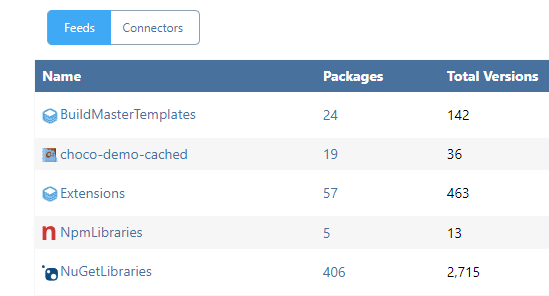
I'm not thrilled about ProGet 2024, but it felt like an improvement... and most importantly, "something different" than past few years:
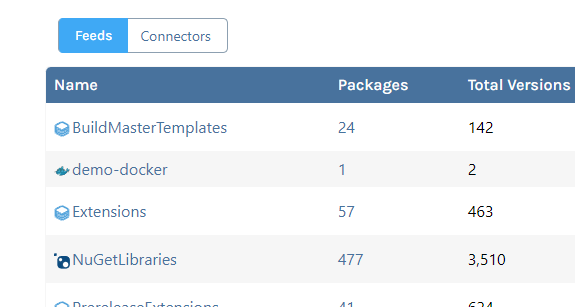
That said, for ProGet 2025 I'd love to do a much more notable style refresh (logos? etc?), perhaps even some navigation tweaks. So open to ideas there
-
RE: [OTTER]Gitlab Secure Ressource gone
@philippe-camelio_3885 thank you, I appreciate that! No plans to give up -- it's a passion of mine, and I feel someday we'll figure out a better product marketing fit :)
-
RE: [OTTER]Gitlab Secure Ressource gone
Hi @philippe-camelio_3885 ,
We'll investigate/fix this via OT-507 in an upcoming Otter release. I suspect it's related to the SDK changes that came out of BuildMaster 2023; we do not test Git with Otter, so it's not surprising it doesn't work.
I really like Otter, but with each major version too many functions change or broken, it's frustrating

Yeah same here; unfortunately we're struggling with "product market fit" so the product is going through changes and
The first versions (v1/v2) were designed as an improvement on the "desired state" concepts from Puppet, Chef, DCS, etc. But the whole "Infrastructure as Code" market never really "took" on Windows. And obviously "no one" uses IaC on Linux anymore thanks to Docker.
In the next versions (v3), we repositioned Otter to be "PowerShell job/script runner" and "compliance as code". This is how most customers used the product, so it seemed like there was a market there. That broke a lot of DSC stuff that hardly anyone used (sadly!)
Very open to ideas on where to take Otter; I think security/compliance monitoring is maybe the right direction, but if that's the case, we need to figure out how to get a lot more pre-built code/scripts in Otter.
-
RE: ProGet SCA 2024 Preview Feedback - Package detection still hit or miss
To make this work smoothly, a webhook for SCA events would really be immensely helpful. Is something like that already on the 2024 SCA roadmap?
We do have a webhook notifier for "non-compliant packages found in build" planned, so perhaps this would be on the list!
When a SBOM scan is uploaded, no issues are created initially even though the UI suggests that analysis was done already. One has to run analysis a second time with the issue checkbox set for issues to be populated.
I just published some preview documentation, but the concept/model is slightly changed here:
When builds in certain stages are analyzed, an "Issue" for each noncompliant or inconclusive package will be created. These are intended to allow a human review and override noncompliant packages.
Basically, the idea is that nearly every build will be created through a CI process and ignored until it needs to be later tested. And that happens later in the release pipeline, after the build is promoted to a testing stage.
Our new guidance will be run
pgutil builds create(basically new name forpgscan inspect) at build time, eactly like it's done now. And the later, when you deploy to a testing environment or otherwise are ready for testing, runpgutil builds promote. At that point, the issues are created.We were thinking to have "Unresolved Issues" present on the project overview page, and it'd be really messy if it's mostly just CI builds.
Hope taht helps explain the thought process.